


Gemini 4 Hydrogen is Google's fast everyday model for AI agents, with the API model name gemini-4-hydrogen, free use through AI Studio and the developer API, paid input at $1.50 for every million tokens, and about 2.5 times the speed of Gemini 3.8 Flash on the same tasks.
It replaces Gemini 3.8 Flash as the workhorse for everyday agent tasks. Google released it on November 12, 2026. According to Google's own results, it scores slightly above the more expensive Gemini 4 Argon on the overall intelligence index.
Where it ranks in the Gemini 4 family
Here is how Google divides the work across the Gemini 4 family today.
| Model | Best at | Good for |
|---|---|---|
| Gemini 4 Carbon | The strongest model, best at deep reasoning and long chains of work | Breaking down plans and tackling the hardest problems |
| Gemini 4 Argon | The second-strongest frontier model | Complex analysis |
| Gemini 4 Hydrogen | Fast and smart enough, strong at execution | Everyday AI agent work, like editing code and running tools |
| Gemini 3.5 Flash-Lite | The fastest and cheapest | Simple tasks at high volume |
The idea behind Hydrogen is simple: most of the time you don't need the most expensive model. This one is good enough, and it's fast.
Benchmarks and speed
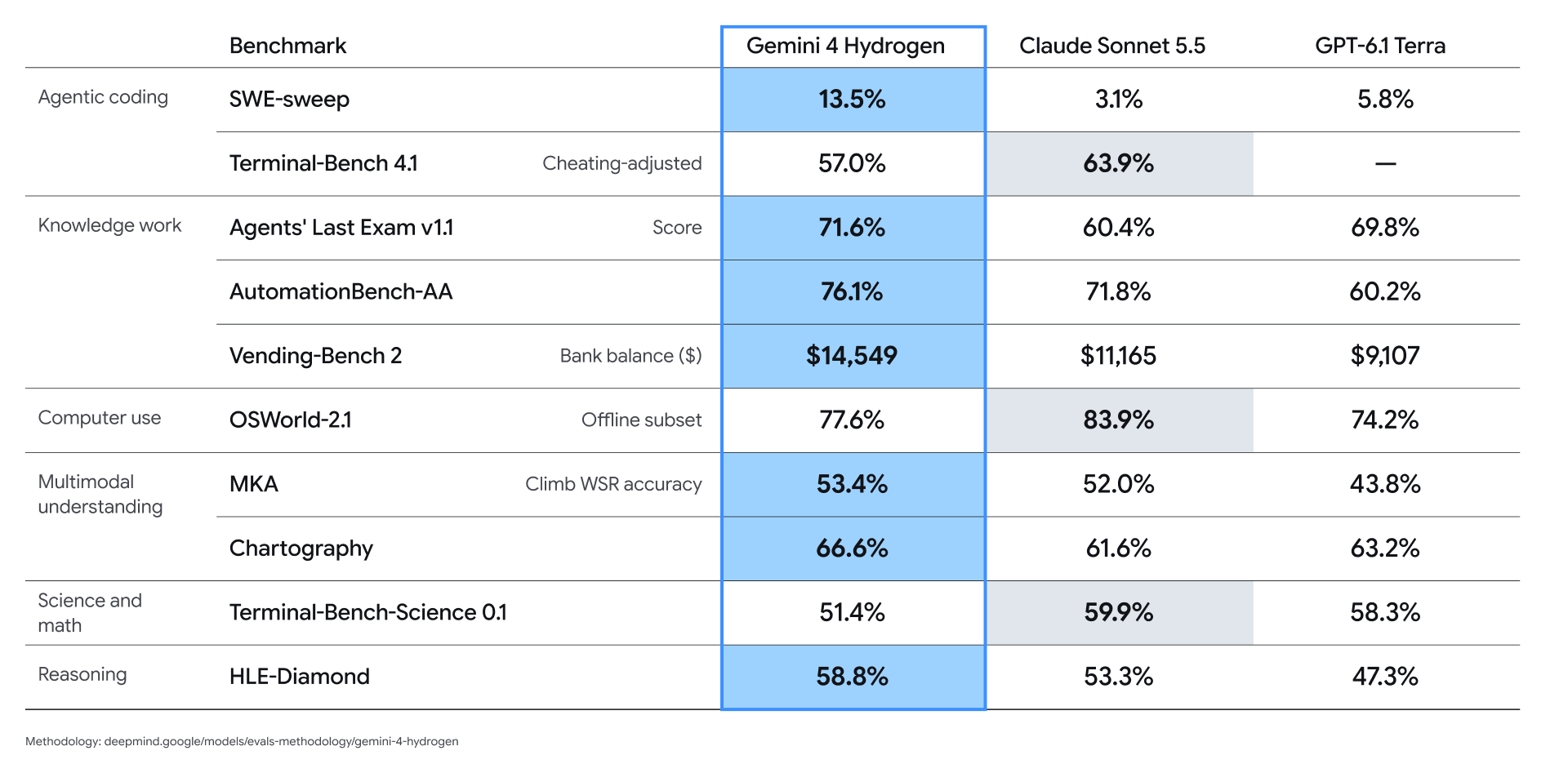
The image comes from Google's official blog. It compares Hydrogen with Claude Sonnet 5.5 and GPT-6.1 Terra, which sit in the same tier. These are the numbers that matter most.
- Artificial Analysis Intelligence Index: 51 at the default setting, slightly above Argon's 50, and up to 54 at the highest thinking level.
- AI agent benchmarks: 71.6% on Agents' Last Exam and 76.1% on AutomationBench-AA, both first among the three models.
- Not ahead across the board: on Terminal-Bench 4.1, OSWorld, and a science-focused terminal task, Claude Sonnet 5.5 scores higher.
- All of these figures come from Google. Independent re-tests from third parties will take a few more days.

The horizontal axis shows the time spent per task, and the vertical axis shows the score. Hydrogen has four thinking depths, from low to extra high. The default is "high." The chart shows that the high setting is already close to the top. Extra high takes roughly double the time but adds only a few more points.
Pricing
| Usage | Input (USD per 1M tokens) | Output (USD per 1M tokens) |
|---|---|---|
| Free tier (AI Studio and Gemini API) | Free, with rate limits | Free |
| Standard paid | $1.50 | $7.50, thinking tokens included |
| Batch and flex | $0.75 | $3.75 |
| Priority | $2.70 | $13.50 |
The price stays the same across the full 1 million token context window, no matter how long the prompt is. Cached input costs $0.075 per million input tokens. Google may use content sent to the free tier to improve its products, so don't put sensitive data in it.
Where you can use it
- Gemini app: You can pick it from the model menu. Free users are assigned it automatically, and it is used when a question suits it.
- Developers: both the Gemini API and AI Studio offer it on free and paid plans.
- Google Search: Search has already switched everyone's experience to it.
- Google Antigravity: Available to AI Pro and Ultra subscribers. Ultra users can also pick the new Orchestrator mode. Carbon plans the work, hands it to Hydrogen to carry out, and takes it back if Hydrogen gets stuck. Google says this gets close to the success rate of Carbon alone, uses 24% less quota, and runs 19% faster.
- Google Sheets and Android Studio: Also supported. Enterprise users can select it in Gemini Enterprise.
The official announcement does not mention Gemini CLI or Vertex AI.
What to watch for if you already use Gemini
Google published a migration checklist for moving from Gemini 3.8 Flash. These are the key points.
- Change the model name to
gemini-4-hydrogen. - The default thinking level changes from medium to high. The minimal level is no longer supported, and sending it returns an error.
- Drop the
top_k,top_pandtemperaturesettings, since the server now ignores them. - Manual context caching (
cachedContents) is no longer supported. Caching is now automatic. - Output limits you hard-coded, such as 8192, can be raised. A single response can now go up to 65,536 tokens.
If you don't want to change the code yourself, give this prompt to your AI agent.
Help me switch the Gemini model used in this project to gemini-4-hydrogen.
1. First list every place that calls Gemini and the model name each one uses now, then wait for my confirmation before changing anything
2. Follow the official migration checklist: drop the top_k, top_p and temperature settings, change any thinking setting of minimal to low, remove the code for manual caching, and raise hard-coded output length limits
3. After the changes, run the most commonly used call once, compare the output with the one from before, and tell me whether anything changed
4. Do not change API keys or billing settings
FAQ
Is Gemini 4 Hydrogen free? Yes. Developers get a rate-limited free tier through the API and AI Studio. Free users of the Gemini app get it assigned automatically rather than choosing it themselves.
Is Gemini 4 Hydrogen better than Gemini 3.8 Flash? Google positions it as the upgrade to 3.8 Flash. In Google's data, the success rate on terminal tasks rose from 18.2% to 57%, and it completes the same tasks about 2.5 times faster.
Gemini 4 Hydrogen vs Argon: which should I use? For everyday AI agent work, use Hydrogen. Its overall index is close to Argon's, and it is cheaper and faster. Save Argon or Carbon for especially long or difficult reasoning.
What is the Gemini 4 Hydrogen API model name and context window?
The model name is gemini-4-hydrogen. It has a 1 million token context window and can return up to 65,536 tokens in a single synchronous response. Longer outputs need background mode.
Can I use Gemini 4 Hydrogen in Gemini CLI? The official announcement does not mention Gemini CLI. The confirmed places to use it are the Gemini app, AI Studio, the Gemini API, Antigravity, and Google Search.
Comments (0)
No comments yet. Start the conversation.