
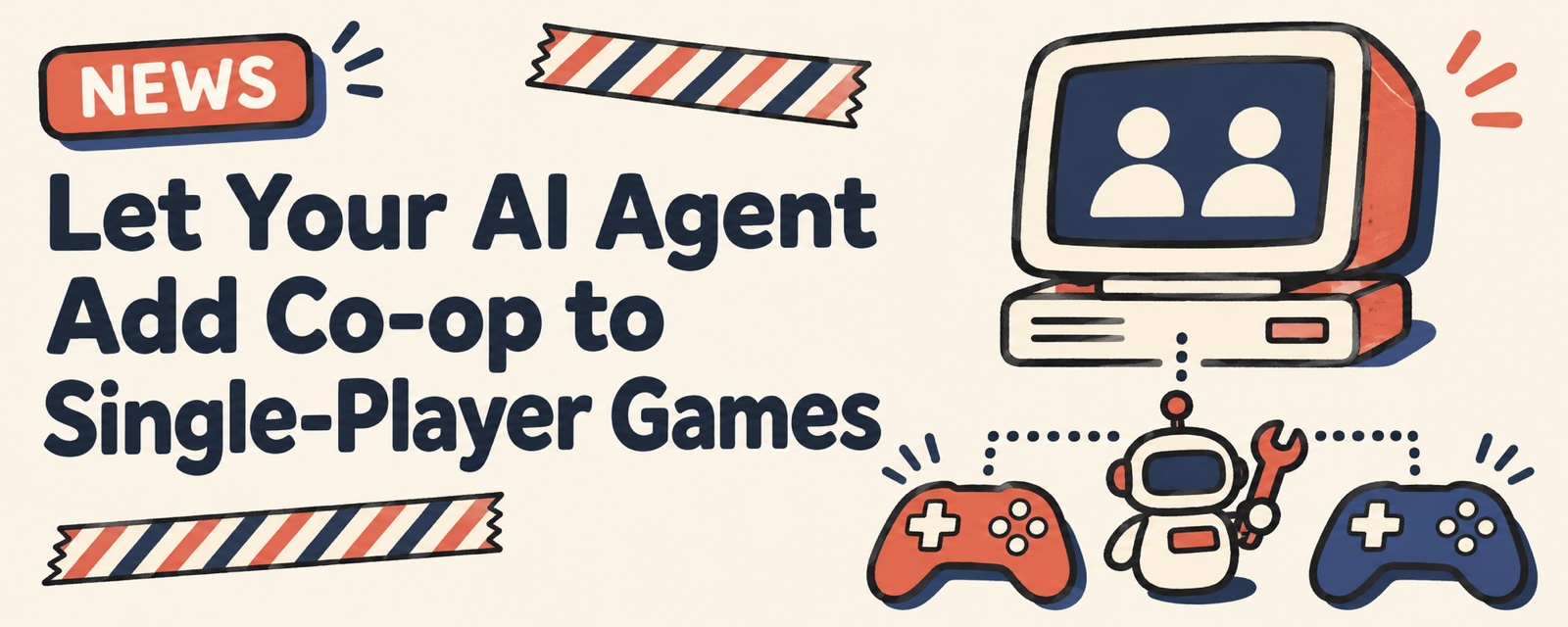
Co-op Anything is an open-source project on GitHub (MIT license, about 2.1k stars). It does a job that once only experienced mod authors could pull off: adding co-op multiplayer to a single-player game. It is not a mod itself. It is a playbook written for AI agents, plus an MCP server and a set of sync testing tools. Tell your AI agent which game you want to play with a friend, and it follows the playbook from research all the way to code. It then uses bots to test sync inside the game and packages the result, so your friend can install it in one click and join through Steam, with no port forwarding.
Games Built So Far
The author's own games are playable or still in progress: Deus Ex (released), Fallout: New Vegas (story co-op, with quests, dialogue outcomes, and reputation all in sync), The Legend of Zelda: Ocarina of Time (fully synced on an open-source port), Dungeon Keeper, and a fix pack for an existing co-op mod for S.T.A.L.K.E.R.: Shadow of Chernobyl. Community contributors added Mega Man X, Pilotwings 64 split-screen, Half Sword, Gothic 3, and Call of Duty: Modern Warfare 2 campaign co-op, along with a dozen or so others. The repo also has a directory of more than 230 games with co-op mods. For each one, it lists what the mod actually syncs and how well it was tested. You can search it online at coopanything.app.
How Your AI Agent Picks a Path
When it gets a game, your AI agent first checks whether someone has already done the work. Then it takes one of two paths:
| Existing mod that needs fixing | Nothing exists | |
|---|---|---|
| Typical case | Old mods often have many bugs or are no longer maintained. Most popular games fall into this group. | Obscure games, or engines that are fully closed |
| What the agent does | Finds the last version, goes through the bug reports players filed, reviews the code, fixes it, and packages the fix separately. | Reverse engineers the game and engine, hooks in so a second player shows up on screen, then syncs enemies, world state, story, level changes, and saves one step at a time. |
| Rough time | According to the project, most take a few days or less. | Depends on the engine. Closed binaries take the longest. |
Both paths end the same way. Automated tests run on real game clients, the result is packaged as a one-click install, online connections go through the Steam relay, and what was learned goes back to the repo as a draft pull request. The next person's AI agent can then build on it.
Difficulty Depends on the Engine
Early Unreal, Source, and id Tech games are the easiest, since they already include networking code. Your AI agent only has to run the single-player logic on top of that network layer. Unity games are patched with loaders such as BepInEx, and Bethesda games use script extender plugins. Older games with decompiled source or an open-source port, like the N64 decompilation projects, let networking be added directly in code. A single closed exe with no documentation is the hardest case. The state, saves, and levels all have to be reverse engineered from scratch, which takes the longest. For console games, the first step is to look for a decompiled or PC-recompiled version. If none exists, co-op falls back to running through an emulator.
Why Its Tests Are More Reliable Than Most Mods
Getting two players onto the same map is not hard. What trips up most co-op mods is keeping both sides in agreement after several hours of play. While building Fallout: New Vegas co-op, the project built a set of tools that don't depend on any specific game. Your AI agent calls them when it needs them:
- Network sabotage: Adds artificial lag, packet loss, and out-of-order delivery between two real clients to see whether sync breaks.
- Desync finder: Records the state of 2 to 4 machines, finds the first moment they disagree, and reduces it to a reproducible regression test.
- Bot playtesting: Runs several bots through a script in the game, compares state across every client at each step, and can check for foot sliding, T-posing, and clipping.
- Multi-instance and hot reload: Runs several copies of the game on one computer, and swaps in new logic after a code change without restarting the game.
Each game entry has a QA level: untested, player feedback, passed automated bot tests, or verified by a human playthrough. Check that column before you download someone else's work.
Getting Started
Make sure you and your friend both own the game first. Then send this prompt to your AI agent:
This game is officially single-player only, and I want to play it co-op with a friend: [game name and its install path on my computer].
Please use the open-source project Co-op Anything (GitHub: cranebeaker/coop-anything) to help me:

1. First read its README and AGENTS.md, and follow the rules in them.
2. Check its co-op mod directory and online sources. Tell me whether this game has an existing mod that can be fixed or whether it must be built from scratch, the reasons for your judgment, and how long you estimate it will take.
3. Before installing any tool (reverse engineering tools, mod loaders, MCP servers), list for me what will be installed and where, and wait for my approval.
4. Before changing any game files, make a full backup of the game folder and my save files.
5. Only build features for playing co-op with a friend. Do not touch any online multiplayer mode or anti-cheat system.
6. After each stage (a second player appears, enemies sync, level changes and saves), stop and tell me what I can play at that point and how to test it. Continue only after I say so.
If you use Claude Code, it reads the repo's MCP configuration automatically after you clone it. Other agents set up MCP as described in playbook/mcp.md in the repo. For games that need deep binary work, the project suggests adding a reverse engineering MCP server as well.
Notes
- Co-op only, no online games. The project rules explicitly ban cheating in other people's multiplayer games and touching anti-cheat systems. Don't use it on games with online modes. You take on the risk of a ban.
- The Steam relay uses a test app. Connections go through Valve's free Spacewar test app, so your friend doesn't need to buy anything extra. Everyone still needs a legitimate copy of the game.
- Building from scratch uses a lot of AI credits. Reverse engineering, syncing, and testing can take days of your AI agent's work or more. If you pay by usage, estimate the cost first, and don't let the agent run unattended for long.
- Check the game's terms for mods and reverse engineering. The project doesn't host any game files, but each game's user agreement takes a different stance on mods and reverse engineering, so read it before you start.
- Review your pull request yourself. Your AI agent submits its results to the repo as a draft. Before you publish, check that there are no game files, save file paths, or personal information in it.
If you want an easier start, read Make Your First Small Game with Godot and an AI Agent.
Project: GitHub · cranebeaker/coop-anything · Co-op Mod Directory
Comments (0)
No comments yet. Start the conversation.