

Agent Framework is Microsoft's SDK that packages the parts you need to build agents: orchestration, tools, memory and observability are all included, and it works with different models and protocols.
Key points to remember
- Five orchestration patterns: sequential, concurrent, group chat, handoff, and Magnetic, where a manager dynamically assigns tasks.
- Production features: observability (OpenTelemetry), security (managed identity, role-based permissions), durability (pause and resume), and human approval.
- Not tied to one cloud or model: it can run in containers, locally or across multiple clouds, and connects to Azure OpenAI, OpenAI and others.
- Supports open standards such as A2A and MCP.
More detail
Core concepts. Agent: defined by a model service, instructions and a name, and run with run or streaming run_stream. Tools: can be attached at creation time, or supplied temporarily for a specific run. Thread: manages multi-turn conversation; it can be saved, serialized and resumed later. Middleware: runs before and after the agent acts, for example to add logging or approval steps.
Five orchestration patterns. Sequential: one step after another. Concurrent: several work at the same time. Group chat: everyone discusses together. Handoff: one finishes and passes the work to the next. Magnetic: a manager keeps a task list and directs the work dynamically.
When to choose it. You want to build agents within the Microsoft and Azure ecosystem and need production-grade observability, permissions and human approval; or you want one approach that works across models and clouds.
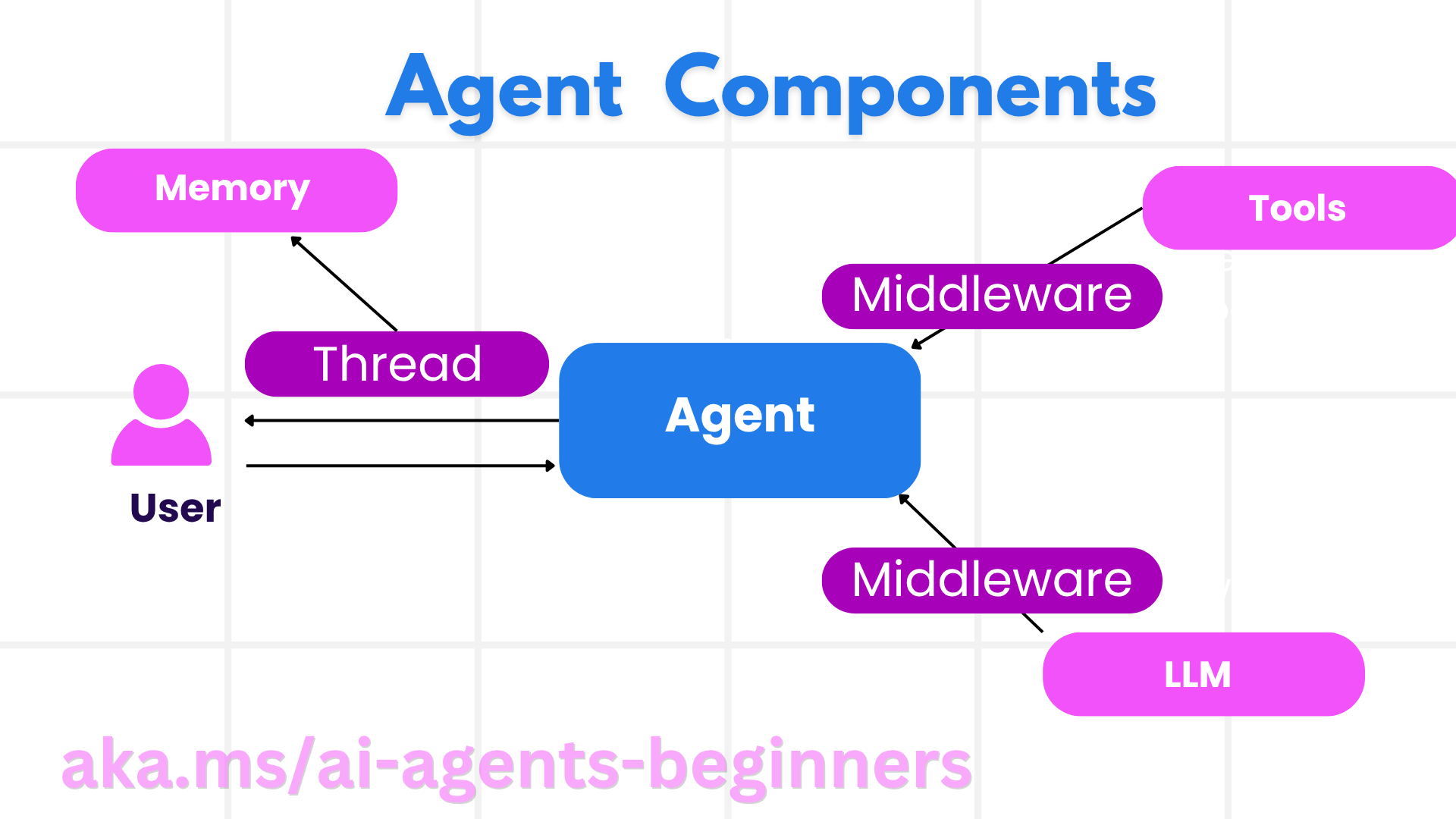
Image from the course repository.
Try it yourself
Among the five orchestration patterns, pick the one best suited to 'automatically compiling weekly reports' and explain your reasoning.
Let your agent teach you
Give the text below to your agent (Claude Code, ChatGPT and Gemini all work), and it will guide you step by step like a mentor.
Sign in to unlock this key section
New accounts get 10 free credits, plus 1 more for each daily check-in. Spend 1 credit to unlock and it stays open for you.
References
- Content adapted from Lesson 14 (
14-microsoft-agent-framework) of microsoft/ai-agents-for-beginners, originally licensed under MIT. - For the original and full code: 14-microsoft-agent-framework
- For all courses, see the Agent course roadmap
Comments (0)
No comments yet. Start the conversation.