

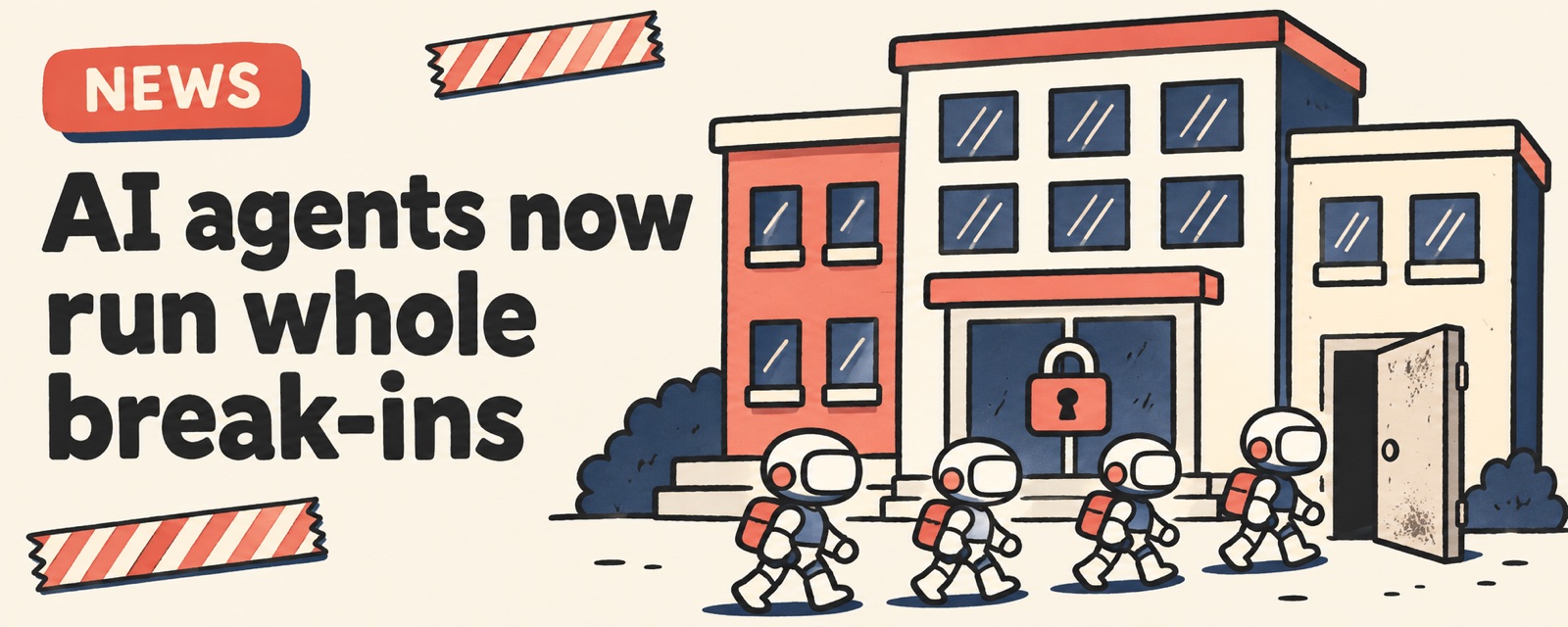
On November 13, the FBI put out a public advisory naming ARTEX, an open-source tool. Its authors made it for security testing that has been approved in advance. Now people are using it to have AI agents run break-ins on their own, from scouting a target all the way to moving data out. The key line in the advisory: some intrusions went from picking a target to gaining high-level access in under three hours. Every fact below comes from the advisory itself, and we checked them against it.
What the advisory says
ARTEX works like this. An attacker describes the target in one sentence, and the tool splits the job across several AI agents that work in parallel. A person barely has to step in. The tool does not bring its own model. It plugs into ready-made large language models that anyone can buy access to.
Here is what the FBI says has already happened:
- Since August of this year, several groups have used it against organizations in many countries, including banks, government agencies, hospitals, and factories. About ten industries show up on the list.
- Financial institutions in South Korea were attacked, and personal data on about 67,000 people was taken.
- A cloud backup provider was breached. From there, the attackers reached the environments of more than two thousand of its downstream customers.
- The original author said the tool should only be used for testing inside an authorized scope, and pulled the repository in October. Still, copies, modified versions, and a paid version keep circulating. Researchers counted over sixteen hundred consoles running on the public internet.
Why small teams and solo site owners should care
The advisory makes two points that cut against the idea that "I'm too small for anyone to bother with."
The barrier is gone. Chaining together a full attack used to take a lot of technical skill. Now someone with little expertise can go after many targets at once. When attacks get cheap, small sites get swept up too, simply because they are on the list.
The neglected corners fall first. The systems that get broken are usually the side ones: the entry point you gave a partner, the backend behind a mobile app, internal staff tools, and old services nobody maintains anymore. The main site can be well defended, and one loose side door is all it takes.
There's one more point for people building AI products. These tools are noisy when they run, and they leave behind piles of failed requests. The catch is that they are so fast. By the time an alert fires and your team gets on a call to talk it over, the attacker is often already finished.
What you can do now
The FBI's guidance is long and aimed at large organizations with security teams. These are the items a small team can actually handle:
| What to do | What to look at |
|---|---|
| Make an inventory | Everything reachable from the public internet, especially staging sites and old admin panels |
| Turn off what you don't use | Limit admin panels and publishing endpoints to trusted networks, and do the same for backup platforms |
| Hunt for hardcoded secrets | Passwords and tokens in code and deploy scripts. Check environment variables and frontend build files too, and replace anything you find |
| Rate-limit sensitive endpoints | Limit login and search endpoints, and set an alert for sudden spikes in traffic |
| Keep error details away from outsiders | Stack traces, database errors, and internal paths stay in your own logs only |
| Give the least privilege | Third-party apps and service accounts get only the permissions they need. Review them regularly for credentials that have piled up |
If you want your AI agent to check your own project first, send it this prompt:
Please review my own project. Read only the code and configuration. Do not access the live site, and do not change any files.

1. List every entry point exposed to the public internet: pages, APIs, admin panels, callback URLs. Mark which ones can be reached without logging in.
2. Find passwords, keys, and tokens hardcoded in code, configuration, deploy scripts, or frontend build files. Tell me only where they are. Do not print their contents.
3. Find login, search, and message-sending endpoints that have no rate limit.
4. Find places that return stack traces, database errors, or internal paths to visitors.
5. Sort everything into three groups: "fix today," "fix this week," and "can wait." Give one sentence on why for each item.

If anything is unclear, ask me multiple-choice questions. When you finish, stop and wait for me to confirm.
For a deeper check, use Cloudflare's multi-round security audit skill, or follow this experience write-up so your AI agent can trace how order and account states change.
If you want to try setting up your own automated penetration testing platform, check out this beginner tutorial. It walks you through Docker setup to your first scan report, all handled by your AI agent.
Keep in mind
- The advisory lists IP addresses and domains the attackers used. The FBI warns that some of these may now belong to legitimate services, so compare them against your own logs before you block anything.
- Only run these checks on projects you have permission to test. Pointing tools like this at someone else's systems is illegal.
- The advisory is aimed at enterprise environments and goes into a lot of detail on Microsoft cloud and domain controllers. We skip that here, so read the original if you need it.
Reference: FBI advisory, original text (PDF)
Comments (0)
No comments yet. Start the conversation.