

A founder packed the idea of "making your company the best at using AI" into a 49-item checklist, running from taking notes all the way to running ads. By the author's plan, once everything is set up, people keep only about 10% of the work: approving things, owning the results, and talking to customers. The list is long, but the core is one line. First write down what the company knows, then hand off work one task at a time, and finally send each task's results back. What decides success is the context you build up. Anyone can buy a model. Only you have your company's customers, decisions, and lessons learned.
The system at a glance
The author's checklist has six layers. We reordered them into "what to do first, what to do next."
| Layer | What to do | Output |
|---|---|---|
| Company brain | Use a Git repo to store Markdown notes: how you think and make decisions, customers, call logs, pricing, and tactics. Attach the reasoning behind every decision. | All the background an agent can look up before it starts work |
| Rules files | One facts file (the agent may only state these facts), one voice file (the wording you like and dislike most, and words you never use), and an AGENTS.md or CLAUDE.md at the top that says what to read first | No more made-up claims, and the writing sounds like you |
| Skills | Rank each workflow by how much it earns or saves, and start with the top one. Do it yourself, narrate as you go, record it, and have the agent turn it into a Skill. | One Skill per task, small and specific |
| Agents and tools | Connect email, chat, payments, and databases through MCP, give the agent a browser, and attach scheduled or event-based triggers | The agent can act, not just give advice |
| Factory | Requirements, parallel development, testing, review, and deployment each have their own agent. Review follows clear standards, and work that falls short goes back. | Each annoying task quickly turns into an internal tool |
| Loop | Write each finished task back to the brain. Every Friday, the agent adjusts the approach based on the week's results, and you review the changes. Each month, cut one thing and double down on another. | The company brain gets thicker the more you use it |
The above is the author's publicly shared approach. No concrete results were published. We haven't tried each of the dozens of tools on the list one by one, and we haven't verified the results.
Why it works: three reasons
- Context is the one thing no one can copy: The same model gives very different advice depending on whether it has read three years of your customer records or nothing at all. Competitors can buy the same model. They can't buy your records.
- Record first, then teach, and the Skill holds up: If you just tell an agent "do sales for me," it can only guess. Do the work yourself first and narrate as you go. The Skill it writes down will include the judgment calls that never made it onto paper.
- Feed results back, and it gets more accurate: After each run, write down what worked and what failed. Next time, the agent won't walk into the same pitfall. Without this step, the agent stays at day-one level forever.
Build it: a six-step SOP
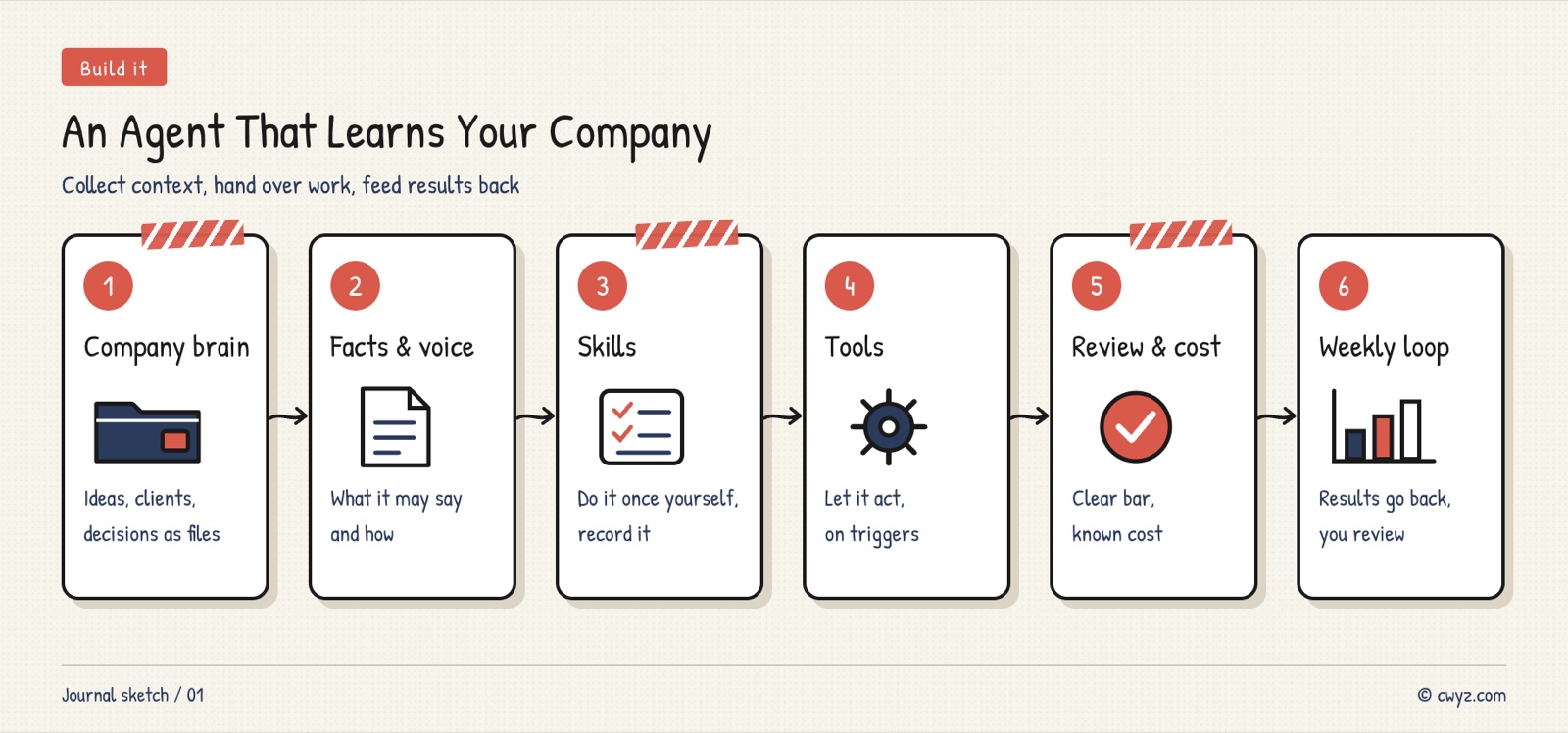
You don't have to set up everything at once. Move forward one step a week. Hand this to your AI agent, and have it check each step against its done-when criteria as it finishes.
Sign in to unlock this key section
New accounts get 10 free credits, plus 1 more each day you sign in (none on days you don't). Spend 1 credit to unlock and it stays open for you.
Safety basics
- Keep the brain repo private: It holds customers, prices, and call contents. Don't put it in a public repo, and don't sync it to a storage service you don't control.
- Approve anything that goes outside: Emails, ads, payments, publishing, and deletions all need your okay, even when they're automated.
- Give accounts the least access: Give the agent its own account for each tool, with no admin rights. Use a separate card with a low spending limit for payments.
- Use a local model for data that can't leave your machine: Customer privacy and contracts should only go to a model that runs on your own computer.
Common pitfalls
- Installing dozens of tools at once: The list has many tools, and connecting them all at once just makes them fight each other. Build the brain and the first Skill well, then add tools one at a time as you need them.
- Saving conclusions without reasons: "Price changed to 99" alone leaves you and the agent guessing six months later why it happened. Record the reason with every decision.
- One giant prompt for everything: It falls apart as the work grows. Split each job into its own Skill. Small, specific Skills are easier to maintain.
- Not tracking costs: Some tasks cost the agent more than they earn. Track the cost of every task, and fix or drop the ones that lose money.
- Letting the agent overwrite the brain: One bad edit can wipe out months of records. Keep everything in Git, append only, and review the changes yourself.
If you'd rather start by giving each agent a shift, read the advanced tutorial Put a team of AI agents to work while you sleep. For a simpler version built for one-person companies, see the case study For a Solo Founder, Single-Job Bots Beat One Do-It-All Assistant.
Where it usually breaks
- 01Installing dozens of tools at once, which then conflict with each other.
- 02Saving conclusions without the reasons, so no one knows why later.
- 03One giant prompt for everything, which falls apart as the work grows.
- 04Not tracking costs, so some tasks cost more than they earn.
- 05Letting the agent overwrite the brain, so one bad edit wipes out months of records.
Comments (0)
No comments yet. Start the conversation.