

Over dinner, a founder who makes money with AI shared a playbook with the author for running a one-person business (OPC). The plan is to test a business in 30 days. For the first five days you build nothing and only talk to potential customers. After that, you hand the routine work of finding leads and running orders to an AI agent, and spend about a week building a version customers are willing to buy. In the final days you work out what each customer costs to win and what they bring in. On day 30, the numbers tell you whether to double down or switch to a different project. According to the author, the founder has earned over 20 million this way. We cannot verify that figure. The most valuable rule in this playbook is the one for day 30: if the numbers are bad, shut it down and move on to the next idea right away.
The 30-day plan at a glance
| Day | What to do | What you should have by the end |
|---|---|---|
| Day 1 | Pick an opportunity: which group of people is stuck on which problem, and can you help them | One sentence that says who you help and what hassle you solve |
| Days 1 to 5 | Build nothing. Go talk to potential customers directly | Evidence that people would pay for this |
| Days 6 to 12 | Set up an AI agent to handle the chores: pull lead lists, reply to inquiries, log orders. Let it do as much as possible first | A daily workflow one person can keep up with |
| Days 13 to 19 | Build the product, but only the version customers are willing to buy | A minimal version that can take payment and deliver |
| Days 20 to 25 | Do the math: how much one customer brings in, how much it costs to win them, and whether they buy again | A per-customer ledger |
| Days 26 to 29 | Keep tuning the AI workflow so it runs faster and cheaper | A lower cost per customer |
| Day 30 | Review the results. If people are paying and the business is growing, double down. If nobody buys and the numbers look bad, switch projects | A clear keep-or-kill decision |
The founder says the math is the most important step. If you spend 200 to win a customer who only brings in 100, every extra customer loses you money, so you should not scale at all.
The dinner conversation above is what the author relayed. The revenue and results have no public data behind them, and we have not verified them or run this schedule ourselves. Thirty days is the founder's pace. Sales cycles vary a lot between industries, so before you copy the timeline, think through how long your own business takes to make its first sale.
Why it works: three reasons
- Find people who will pay before you build: The most common failure is building heads-down for months, only to find no paying users after launch. Talking to customers first tells you cheaply whether anyone wants this at all.
- An AI agent takes the repetitive work, so one person can run the whole line: Tasks that used to require a hire, like answering inquiries and sorting orders, can be drafted by an agent first. You only judge and decide. The cost of testing one project drops a lot.
- Let the ledger decide, not your gut: What it costs to win a customer, what they bring in, and whether they buy again all sit in one table. That makes the day 30 decision hard to fudge. A failed test costs only one month, so in a year you can try a dozen directions.
The six-step SOP
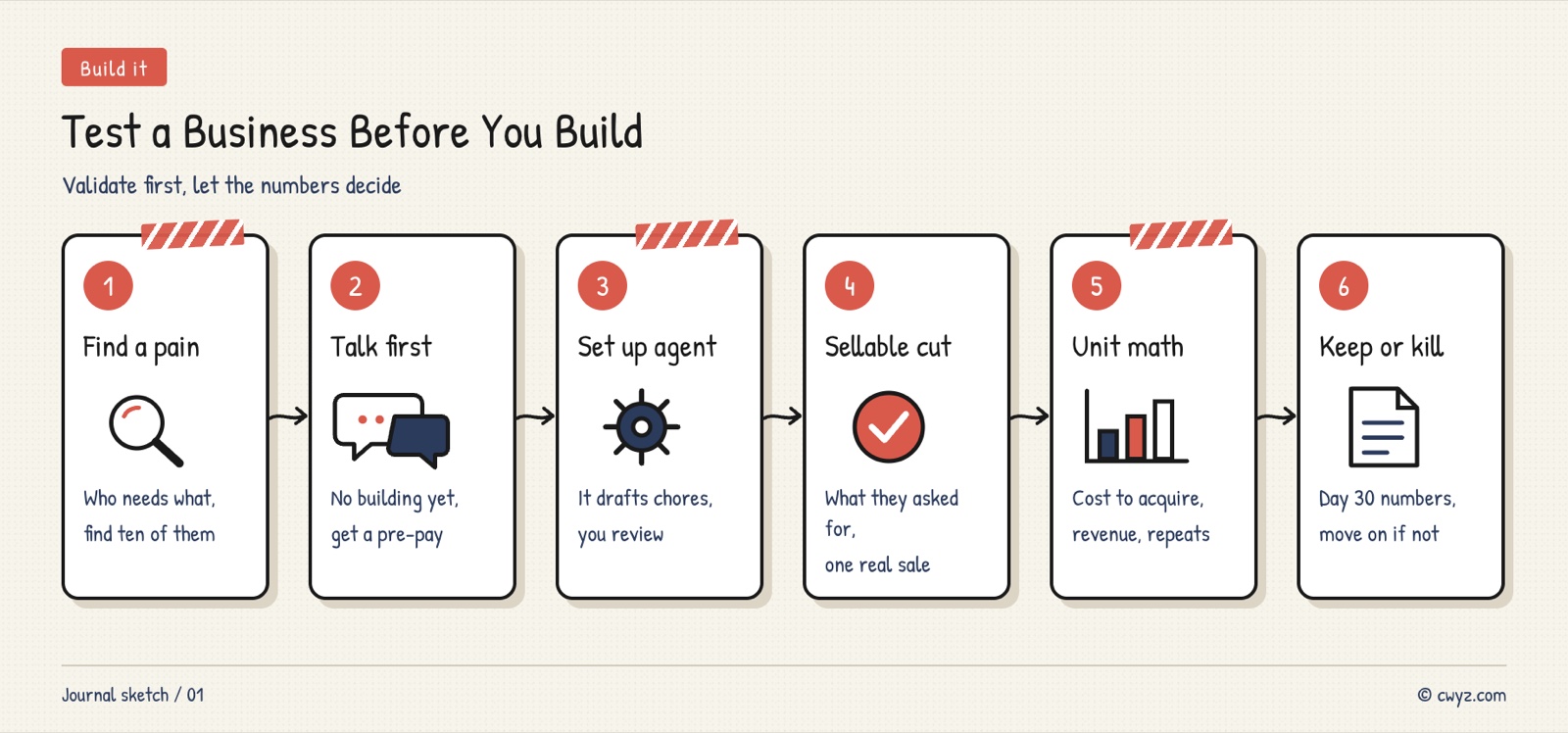
Give the table and the template below to your AI agent and ask it to act as your business partner. After each step, check yourself against the done criteria. You handle talking to customers, collecting money, and making the final calls.
Sign in to unlock this key section
New accounts get 10 free credits, plus 1 more each day you sign in (none on days you don't). Spend 1 credit to unlock and it stays open for you.
Safety rules
- Follow the rules when finding customers: Reach people through public channels and your own network. Do not send mass unsolicited messages or buy lists of unknown origin. Follow platform rules and personal data protection laws.
- You handle the money: You personally collect payments, process refunds, and change prices. The agent only records and reminds you, and it never touches payment accounts or passwords.
- Review anything public before it goes out: Check every customer service reply and promotional message the agent writes before it is sent. Do not promise features the product cannot deliver. For pre-orders, state the delivery time and refund policy clearly.
Common mistakes
- Building before finding customers: You spend three months building, then find nobody wants it, and the time and money are gone. Talk to 10 people before you write a single line of code.
- Looking only at revenue, not acquisition cost: Sales look like they are growing, but each new customer loses you money. Run the per-customer math once a week.
- Handing the agent the job and walking away: An auto-reply says something wrong or an order gets lost, and customers leave. Keep a person reviewing anything public.
- Refusing to shut down: The day 30 numbers are clearly bad, but you want to "push on a little longer." Write the shutdown criteria in advance and follow them when the day comes.
- Forcing the 30-day schedule: Some businesses have long sales cycles, such as enterprise sales. Adjust the length of each stage to your industry, but keep the order: validate first, build second, and decide by the ledger.
If you want more reasons to get an order before you start building, read this experience: Every feature built and still no one pays? You probably started in the wrong order.
Where it usually breaks
- 01Building before finding customers, so nobody wants the product when it is done.
- 02Looking only at revenue and not at acquisition cost.
- 03Handing work to the agent and walking away.
- 04Keeping a failing project because you cannot bring yourself to shut it down.
- 05Forcing the 30-day schedule without checking your industry's sales cycle.
Comments (0)
No comments yet. Start the conversation.